Kyle Simon also contributed to this story.
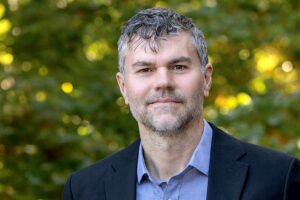
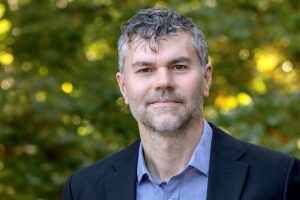
Dr. Steve Fraiberg joins the WRAC faculty as someone who calls himself a teacher-researcher because he believes that teaching and research are both highly interconnected and integral in succeeding as a new faculty member and as a professional.
Fraiberg received his bachelor’s in English from University of Michigan, received his MA in technical communication from Rensselaer Polytechnic Institute, and finished his formal education with a PHD in English with a concentration in writing studies from the University of Illinois in Urbana-Champaign. His research involves language and culture, and how culture shapes who people are and how they communicate. Part of that interest includes multi-lingualism, and this has led Fraiberg to teach and work in several places in the U.S. as well as in Israel, both as a professional at a high-tech company and as a teacher.
While in Israel, Fraiberg broadly focused on the language and cultural shift in Israeli society. He looked at the transition there of socialist culture to a more capitalist one that also seemed to be mirrored in a language shift from a great deal of Hebrew to more of a mix of Hebrew and English in a variety of settings.
Fraiberg is interested in looking at reading, writing, and design practices across disciplines, from learning in the classroom to companies to design. “This reflects my range of teaching and research interests and also my range of interests present in WRAC, including First-Year Writing, Professional Writing, language and culture, and teaching and research,” Fraiberg says.
In addition to WRA 1004, he currently teaches WRA 320 Technical Writing and is focusing not just on introducing his students to the basic concepts of technical writing but also getting them to apply those basics and skills to opportunities for social entrepreneurship. Besides teaching, Fraiberg is also working towards establishing a Start-Up Weekend for students to get together for 52 hours in order to pitch start-up company ideas to a jury, hopefully to be awarded money for the most promising pitch. Additionally, he is beginning to organize a group of undergraduates interested in globalization and internationalizing writing and business. About professional writing students he says, “I like professional writing students because they are, well, professional and have a humanistic-creative bent. It is this combination that I think is a strong one.”
When he isn’t teaching or creating opportunities for students to get involved, Fraiberg is also working on a book proposal titled English, Israel, and Globalization: Life is No Kibbutz, a compilation of his research from Israel and a reflection on the shift in Israeli society from a socialist system to more an individualistic one.

Photo credit: steinhardt.nyu.edu
New faculty member Dr. David E. Kirkland is certainly a well-accomplished addition to the WRAC department. With about 50 published articles, books, and book chapters, and over 100 presentations nationwide about his scholarship, Dr. Kirkland has been making the most of his time. Yet he still strives to continue researching and to be actively involved in making a difference in as many lives as possible through his very ambitious research agenda and consuming passion for teaching.
In 2006, Dr. Kirkland received his PHD from MSU in Language, Literacy, and Urban Education and then went on to teach and research at New York University. What motivates Dr. Kirkland to keep learning, discovering, and equipping educators with tools essential for making an impact on students and communities is the culture of the English language and how it is used to help people experience the world around them. This motivation is what drew him to his current position at MSU, where he feels he can have an impact on teaching and learning while doing valuable research.
His Black Male Literacy Project, which builds on research that spans a decade, focuses on mapping ways in which black males read and write–ways that aren’t necessarily valued in public spaces like schools. His goal is to prove that the deficit theory of black males not being readers and writers is false. He now seeks to develop ways educators can engage this demographic so that students are comfortable responding postively and artistically in formal classroom settings.
Another of his foci deals with transnational comparative English education. In his Comparative World Englishes project, Dr. Kirkland examines ways that English is taught, thought about, and understood as a language in a variety of global contexts–that English, in fact, comprises a cosmopolitan thread that binds people beyond borders. This work ties in to his current position at CAITLAH, the Center for Applied Inclusive Teaching and Learning in Arts and Humanities. The focus of CAITLAH is to develop excellence in teaching and learning for faculty, graduate students, and K-12 teacher candidates around issues pertinent to pedagogy in the arts and humanities. A goal of Dr. Kirkland’s work with CAITLAH is to work within the professional ecologies of education to understand and enhance teacher education by using networks where teachers jointly construct knowledge that will help them become better prepared to teach in 21st-century classrooms.
Dr. Kirkland teaches AL 992 Seminar in Language, Literacy and Pedagogy, which centers on helping future educators learn how to teach English literature with a focus on urban youth cultures, language, and composition. About his drive to teach and ultimate goal to help educators he says, “If we’re going to mobilize a new society around respect and tolerance, and if we’re going to spark creativity and intellect to shapes new economies, then teaching in socially just ways needs to be the framework of practice that guides our transformative work.”

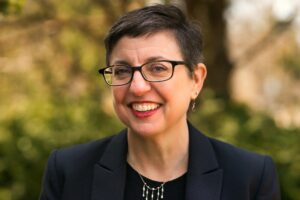
Dr. Joyce Meier, Photo by Kristel Klank
Dr. Joyce Meier says of her recent appointment as associate director of First Year Writing (FYW), “[The appointment] totally surprised me! It’s been great fun, and I have nothing but positive things to say.”
Despite the surprise, Meier wasn’t deterred by the position and is busy setting goals for herself as well as for the program, its students, and its faculty. A basic task involves helping the FYW director, Julie Lindquist, engage with other departments and programs (such as the English Language Center) to determine how they can best work with WRAC faculty to serve the students they share.
Besides this, Meier strives to find and create opportunities for open communication, pedagogy workshops, writing groups, reading groups, and simply opportunities for colleagues to be a network of support. Meier says, “How do you combine the rich, diverse backgrounds of this faculty and get them to connect because of their similar experiences in teaching? I’m trying to create as many opportunities as possible for them to discuss and share effective ways to approach the classroom as well as brainstorm solutions to common issues.”
Such opportunities include a new mentor group for fixed-term faculty and workshops on specific FYW pedagogy, like how to teach the disciplinary and multi-modal assignments, and how to incorporate heuristics like revision, invention, and arrangement into FYW teaching. In addition, Meier has jump-started three different workshops, a reading group that meets once a month to discuss related scholarly articles in the field of composition studies, and meetings of faculty who teach the same themed writing courses, so that they can share and discuss syllabi and course materials. The topics for these workshops and meetings were in direct response to a faculty survey Meier conducted at the start of fall semester. Her overall goal with these various forms of outreach is to create support for FYW writing faculty as well as to allow for creativity and innovation to be freely shared among them.
Meier relies on her many years’ experience teaching (prior to coming to MSU, she taught at University of Michigan and University of Iowa) to understand the position of assistant director. At MSU, she’s been teaching WRA 135 Public Life in America, a service-learning course; her experiences with these students have given her insight into different ways faculty can together find innovative solutions to common problems. Meier says, “Students are so profoundly moved and changed by the work and by learning to problem-solve together. You find that the answers are all right there and all the talents and gifts are in the room. It’s just a matter of making opportunities for those gifts to arise. This is the same thing for mentor groups.”
Overall, Meier is excited about her new position and eager to make a strong positive contribution to the FYW program.
Professor Laura Julier, associate chair of WRAC and director of the Professional Writing Program, was recently selected as the new editor of Fourth Genre: Explorations in Nonfiction. She is excited with the new position because “studying, writing, and teaching nonfiction has been the core of my professional work for a long time,” she says, “so being chosen to edit this journal is a huge and wonderful thing.”
Fourth Genre is a literary journal dedicated to publishing notable and innovative work within the genre of nonfiction. (The title refers to the fact that the traditional canon for teaching literature focused primarily on the genres of fiction, poetry, and drama.)

Fourth Genre editorial staff
photo by Kristel Klank
Under the previous editor, the journal has progressively broadened from its original focus on personal essays and memoir to welcoming alternative forms of nonfiction, including photo essays, graphic essays, and works that blur the lines between genres. Julier says she is committed to maintaining the long tradition of excellence. Works by a number of the journal’s editors and writers have won awards, the most recent example being the inclusion of eight essays published in Fourth Genre in the Notables list for Best American Essays 2011.
Having Fourth Genre in WRAC and having Julier as the editor provides huge opportunities for students in both the Professional Writing and Rhetoric and Writing programs. Julier says, “I’m particularly happy to be able to bring the resources and opportunities that the journal affords to the [Professional Writing] program. The R&W PHD program has a concentration in nonfiction writing, so this also increases opportunities for graduate students.” She also talks about the ways in which the journal complements the PW curriculum: students in the editing and publishing track can gain invaluable experience as part of the editorial staff on a nationally recognized journal through internships.
Six students are currently doing just that: Lauren Ebelt and Kimberly Tweedale (both Professional Writing seniors), Ziev Beresh (senior English major), Christine Scales, (Interdisciplinary Humanities major), Natalie Graham, who’s writing her dissertation in American studies, and Katie Livingston, who’s in the R&W PHD program. Interns read and screen submissions, log and organize manuscripts, and help oversee the production of the journal. Ebelt comments that she is gaining experience in evaluating manuscripts to determine what makes a really good piece of nonfiction writing, a skill that will be valuable to any publishing house.
Working for Fourth Genre, with support from the College of Arts and Letters and the MSU Press, will enable all the interns to travel to Chicago in February to the annual Association of Writers & Writing Programs conference. “The ability to provide talented students with this kind of experience, this visibility and a connection to this kind of notable, national publication, in a way that will give them a significant advantage as they seek professional positions in literary editing and publishing,” said Julier, “is absolutely the most satisfying part of being named editor.”
Thomas Gregovich also contributed to this story.
The MSU Rhetoric & Writing graduate program graduated four PhD students during the spring and summer 2011 semesters. Guiseppe Getto, Stacey Pigg, Jessica Rivait, and Douglas Walls each successfully defended their dissertations, and accepted positions as assistant professors at universities across the country.

Photo by Guiseppe Getto
Guiseppe Getto’s developed heuristics to collaboratively and sustainably contribute to community infrastructures through writing. He argues that students in his service-learning class “mobilized and invented different kinds of knowledge depending on what technologies, modes, and genres they had access to.” Because of this, his students formed a strong network of skills, ideas, and resources with community partners. Getto also argues that it is “important for student writers to engage in new media projects that respond to social problems of common concern to community members.”
He accepted a position at SUNY-Cortland, where he’s teaching and researching digital writing, service-learning, and community projects as an assistant professor of New Media, Rhetoric, and Professional Writing.

Photo by Stacey Pigg
Stacey Pigg studied the everyday writing practices of people who spent time writing in a coffee shop in Lansing. Her dissertation argues that “many people go to coffeehouses for getting work done while maintaining a social balance–people tended to feel less lonely at the coffee shop than when working at home, but were able to avoid lengthy face-to-face conversations that make completing writing work difficult.” She also argues that people tend to keep up with friends, family, news and information online using social media while they worked in the coffee shop. Pigg accepted a position as an assistant professor of Writing and Rhetoric at the University of Central Florida in Orlando. She and Doug Walls work at UCF together in a new Writing and Rhetoric department.
Jessica Rivait studied the digital writing practices of two Lansing area community initiatives, where she developed a model of public rhetoric that accounts for the ways that local publics are assembled. Rivait argues that roles, chronos, and conditions of access are key factors that impact how local publics are assembled and, ultimately, if and how they are sustained. At Cazenovia College, in Cazenovia, NY, she teaches first-year writing courses that focus on critical reading and research.

Photo by Doug Walls
Doug Walls theorized and traced “access not as a trait to be assigned to individuals or in reference to specific technologies but instead as moments of accessing enacted by people, tools, and cultures in professional and personal lifespheres.” His dissertation demonstrates that “attention to social media, careers, and lived cultural experiences when placed alongside traditional concerns of access give us new insights into the interconnectedness of new media writing.”
Walls accepted an assistant professor position at the University of Central Florida in the Writing & Rhetoric department
where he works with fellow MSU alum Stacey Pigg.
Thomas Gregovich also contributed to this story.
One of the strengths of the Professional Writing Program is its alumni. So many have gone on to do such interesting work. “While at Beer Rhetorics one night, Laura Julier was discussing the fact that PW students never get to see the alumni. I decided to take initiative and organize a field trip to go see alumna Sarah Aldrich,” said PW senior and Beer Rhetorics evangelist Ali White. Sarah Aldrich, currently the marketing coordinator at Founder’s Brewing Company, graduated from PW in May 2010.
It took Ali forever to find a date agreeable to all, but they finally settled on September 23rd, sign-up began, and as the date drew nearer, White approached Professor Danielle DeVoss about joining the field trip. She hopped right on board and offered to sponsor vans to take the students and faculty to Grand Rapids.
Founder’s Brewing Company is an award-winning craft brewery that began in the dreams of Mike Stevens and Dave Engbers. To accompish this dream, they quit their jobs and took out huge loans; a huge risk. After getting off to a shaky start, Engbers and Stevens decided to change up their strategy. Instead of brewing unremarkable beers that catered to all crowds, said Engbers, they decided to craft “complex, in-your-face ales, with huge aromatics, bigger body, and tons of flavor,” says the Founders website. “[We] are brewing beer for a small cadre of renegades and rebels who enjoy a beer that pushes the limits.”
After arriving at downtown Grand Rapids, students and faculty met their tour leader and Founders creator, Dave Engvers. Along the tour, the group learned of the founding of the company, the brewing process, and the expansion of the brewery.

After the tour, they admired Sarah’s office, the really cool meeting room, and headed off to dinner in the taproom, courtesy of DeVoss, while enjoying delicious samples of beer. After dinner, some of the PWers headed into downtown Grand Rapids to check out ArtPrize, an annual art festival that hosts local artists.
“It was wonderful to tour the brewery and to see all of the art spread around the city. I can see why they call Grand Rapids the ‘shining star of Michigan’,” said resident mentor and TechSmith social media intern Ali White.
“As a senior, I was looking for a way to give back to the major beyond the supporting the established student groups,” said White. While at Beer Rhetorics one night, White decided to take on (another) title as PW Field Trip Coordinator and began organizing the first trip. This was about more than a field trip, though. “PW is a great program, but it only gives you the skills. We cannot expand our roles and knowledge without the help of others. We must rely on one another for networking and connections. We have the opportunity to be a powerful force in the information industry,” said White.
Although she has started work on the second PW field trip, Ali is looking for somebody to take over the position of PW Field Trip Coordinator after she graduates in December. If interested, contact Ali or Laura Julier for more details.

Professional Writing major Clare Zammitt published this piece in Capital Gains, a commercial online magazine that covers “creative class” culture in the mid-Michigan region. This feature article tells the story of a scavenger hunt organized by a local attorney, in which participants compete to locate visually-intriguing landmarks in Lansing. Clare did field research, conducted interviews, and helped Capital Gains photographer Dave Trumpie arrange photo shoots.
The article fulfills Capital Gain’s mission to showcase Lansing as a vibrant city, full of interesting people doing interesting things.
Clare credits two PW courses in particular with helping her enter the world of paid freelance writing. “WRA 202 [Introduction to Professional Writing] taught me the importance of audience, and how to research a publication before I decide to write for them.” She also points to WRA 308 Invention in Writing, taught by PW associate professor Leonora Smith. “It helped me hone putting personality into my work, something that’s fun to do with feature writing.”
Clare went on to refine her feature writing in WRA 355 Writing for Publication, taught byJonathan Ritz, where each student develops, writes, and pitches a freelance feature article to Capital Gains.
See the full article.
Photo credits: Dave Trumpie

Assistant professor and newly appointed PW adviser Jonathan Ritz
WRAC is pleased to announce that assistant professor Jonathan Ritz has been hired as the primary Professional Writing academic and professional adviser. Starting at the end of the fall 2011 semester, Ritz will begin meeting with the majority of new and incoming majors to discuss topics such as courses, internships, networking, and of course to help them map their progress toward the degree.
“When the opportunity arose to take on a larger role here, I jumped at it,” Ritz said of accepting the position. “There’s a really positive charge to this program, a great sense of forward momentum, and that’s the kind of place you want to be part of.”
That momentum is also why the additional advising position was initially created. The steady growth of the major (currently consisting of more than 150 students), and the one-on-one attention students receive for both academic and professional advising has contributed to the increased demand from students. Ritz believes his previous advising experience prepared him to carry out the new role with the commitment it requires, saying, “it’s demanding work but can be very rewarding.”
Fellow faculty member and Professional Writing professor Danielle DeVoss agrees, calling Ritz a “champion” of the program, and assures students that he will “continue to deliver on the promise of excellent advising” the major was built on. “I am absolutely thrilled.”
Along with his advising role, Ritz will continue to teach in the program. He has taught courses in the editing and publishing track for several years and teaches WRA 355 Publication Workshop during the summer as well.
Current Professional Writing students close to graduation will still be able to meet and receive aid from their existing adviser, but the goal is for Ritz to work with a majority of students regarding all of their academic and professional needs.