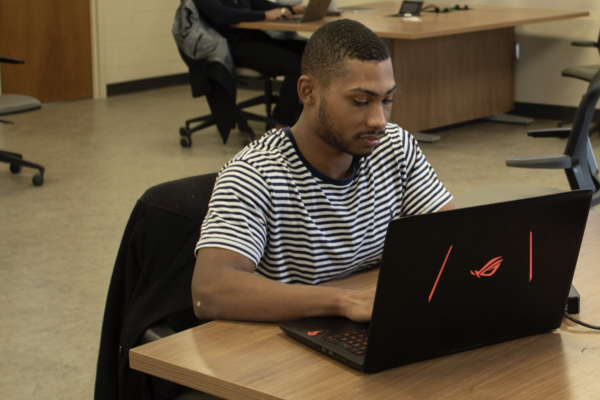

A large portion of the population is addicted to Twitter, Facebook, or some other form of social media. A lot of you reading this probably got to this post from a link on Twitter, right? I thought so.
This post from Cool Infographics demonstrates the “Social Network Overload.” A lot of people feel unplugged if they don’t check their social media accounts. 62% of people are afraid they will miss something if they don’t check, and 40% of people said they would rather run a marathon, get a root canal, or wait in line at the DMV than get rid of their social profile.
Are you a victim of social media overload? Check the rest of this infographic to find out!
This is pretty much the coolest couch, ever. Designed based on the theory that “sooner or later, at home or at work, we all end up by falling asleep on our computers keyboard.” With that, these designers created this soft, comfy sofa bed, designed to look like a keyboard.
What’s more, the couch is completely customizable by remote. Each cushion, or key if you may, can be adjusted to any height.
I want this couch in my home! Do you? Check out more pictures here.
Each year there are new trends in technology, hairstyles, and fashion that people try to keep up with. The same is true for fonts. Whether you are aware of it or not, some people are following font trends each year.
Popular designs for 2013 are grunge fonts, which give your work some extra attitude; big and bold fonts, perfect for creating amazing headlines; handwritten fonts for personality; and stencil fonts, for a blast from the past.
What is your favorite type of font? Do you follow any font trends?
Twitter is famous for sharing information in only 140 characters. Beyond sharing thoughts, general life updates, and news dissemination—a few of the typical ways Twitter is used—is the idea of using this site as an educator to stay connected with students and parents. Mind/Shift details 28 different ways we can teach through tweets.
One of these is to use Twitter to encourage student discussion to continue beyond the classroom. By connecting the students on one platform, and with things like hashtags to keep organized, they can ask questions, share ideas, and continue their group learning beyond the allotted class time. Another of the 28 ways is that it allows announcements to happen in “real time”; the cancellation of class, an update on a project, etc., can all be shared immediately to a social media platform many students are already regularly checking (potentially unlike their email inboxes).
It can also help students create professional online networks. For those who are already tuned into Twitter, it can be used to help teach them how to politely connect with those in their desired job field. For students who aren’t as familiar with the site, it teaches them how to effectively communicate, all while helping build their personal brand.
Personally, I have often seen professors syllabi stating when students send emails, it should have a clear and detailed subject lines, and if the message itself is more than five sentences, the students should come into office hours instead. This is another issue than can potentially be sidestepped by educators using Twitter; students would need to be concise as they only have 140 characters, and teachers wouldn’t need to spend as much time sorting through piles of emails. What are other ways Twitter can be used to expand education? Let us know on Twitter! – @msuwrac
Malea Powell was recently interviewed on MSU Today as part of their Faculty Conversations. Malea, who has worked at Michigan State for over ten years, spoke passionately about her work and the students she’s had the opportunity to teach.
As former Director of the Rhetoric and Writing graduate program, Malea is especially enthusiastic about higher education. “I like working with Ph.D. students because I like the idea that I’m producing my colleagues. Those will be the folks I’ll eventually be in my discipline with and that’s very exciting.”
Her specific interest in the discipline focuses on “American Indian material rhetorics and the degree to which these ‘everyday’ arts are related to written rhetorical traditions…I’m really interested in the connections between material makings—like basket weaving—and textual makings, like writing.”
To learn more about her research, her contributions to the Conference on College Composition and Communication, and her work here at MSU, read the full MSU Today article here, and enjoy her interview below.
Searching for a little inspiration in your day? Brain Pickings is always a good place to look, but there is one article in particular that is well worth your attention. It features a poem by Pablo Neruda, a Chilean poet, titled “Ode to the Book.” Translated into English, it speaks of life, books, perils, mythology, and travel in such a beautiful and mystifying way that it makes your fingers itch to pick up a pen and start writing your own stanzas. And as if that wasn’t enough on its own, you can also listen to the poem being read by the deep, gravelly voice of Tom O’Bedlam, who has narrated many classic works. Enjoy!
In Professional Writing, students learn a wide variety of skills, ranging from web design, to grant writing, to editing. Along with learning these skills, Professional Writing students have the opportunity to focus on real life situations and apply these skills on projects with real clients. Stuart Blythe’s WRA 202: Introduction to Professional Writing class got the opportunity to work with the Office for International Students and Scholars (OISS) on projects concerning international student relations.
OISS is an office that prides itself on giving support to MSU’s international students, scholars, and families. They provide advising, help with immigration standards, and conduct orientations to help international students adjust to life at MSU. They also serve as a liason between US Government agencies, foreign embassies, and sponsors, and provide opportunities for growth at MSU.
Over the course of the semester, the WRA 202 students worked on two different projects for OISS.
Their first task was to redesign the program’s Curricular Practical Training (CPT) forms. These forms are used by international students in order to get work-study internships in the US. Prior to the PW students’ help, these forms were overly long and instruction heavy, and were often being filled out incorrectly by students. Kelsi Lerner claims this project helped develop her skills as a professional writer, especially in regards to audience. “Not only did the projects have to be clear and simple enough for your average reader to understand, but also an International student who may have a minimal understanding of the English language. I think in this way, the projects really helped me understand how to write well, not just subjectively speaking, but also for the audience that my writing is directed at.”
The second project was to design a communications strategy for OISS with the goal of increasing interaction between international and US students. OISS wanted to increase attendance at their events to help international students form relationships here at MSU. In order to do this, the students researched relations on campus among US and international students, and brainstormed ways to encourage students to participate more in outreach events planned by OISS. Anna Meyers, a student in the 202 class, said that “the biggest challenge in this assignment was coming up with something new. We had to think of a strategy that hadn’t been done before.” (more…)
One project usually tackled by students in first-year writing courses is a “Remix” project, in which they take a paper they have previously written in the semester, and make a multimedia project that delivers the same message as their paper. Lessons learned from this assignment include how to communicate through different mediums—from words to images, videos, or songs—as well as how to look at their work from different perspectives, through different lenses.
It has the tendency to turn things on their heads a bit, which is good because it gives us the chance to examine how and why we view things the way we do, and the effect that has on our opinions and decisions. For example, here are a few examples of what modern songs would look like as retro vinyl:
Welcome to our department. We have played an important role in writing instruction in US universities for a long time. We were founded in 1944 as the department of Written and Spoken English as part of widespread changes in higher education in the post-war period. Such a department was fairly unique at that time, and our faculty were important to how writing instruction developed in higher education.
Today, we continue to lead and are committed to preparing excellent communicators in the culturally, technologically, and economically dynamic environments of the early 21st Century.